We are very honoured that SAMEMES 2022 will be host to the following illustrious keynote speakers.
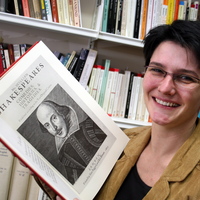
Professor Pascale Aebischer
Pascale Aebischer is Professor of Shakespeare and Early Modern Performance Studies at the University of Exeter. She specialises in the history of the performance of early modern drama, with an emphasis on 1580s-1700 and 1980s-present. Her two most recent books are concerned with how digital technologies have transformed how we watch Shakespeare. Shakespeare, Spectatorship and the Technologies of Performance (2020) develops work in phenomenological approaches to performance and spectatorship, as well as work on digital performance, scenography and theatre architecture and reconstruction. Viral Shakespeare: Performance in the Time of Pandemic (2021) investigates the effects of binge-watching Hamlet in lockdown, thinks about what it’s like to watch Shakespeare in languages other than English, thinks through the concept of ‘Zoom performativity’ and looks at how theatre-making in itself became a political message in the face of Covid-restrictions and economic hardship and marginalisation for the creative industries.

Professor David Loewenstein
David Loewenstein is the Edwin Erle Sparks Professor of English and the Humanities, and the Director of Graduate Studies at Pennsylvania State University. His research interests include early modern literature and culture from the Reformation to the Restoration; Milton and his contemporaries; English literature in relation to politics and religion; the relations between literature and history; the impact of ancient Greek history and culture on early modern literature; book history; and Shakespeare. His recent work has addressed early modern English literature in relation to such topics as the construction of heresy, nationalism, and concepts of tyranny and he has published widely on early modern history and culture. His current research projects include a forthcoming book entitled Tyrannical Powers: Representations of Tyranny in Milton’s England and Early Modern Europe, a study examining how ideas and theories of tyranny became the subject of fresh interpretation, intense debate, and representation in Milton’s age, and editing Paradise Lost for the new Oxford University Press edition of The Complete Works of John Milton.

Professor David Matthews
David Matthews is the Professor of Medieval and Medievalism Studies at the University of Manchester. His current work is on the continuities of Middle English literature into the Tudor period, and he co-edited a collection of essays entitled Reading the Medieval in Early Modern England in 2007 on this theme. He is interested in most aspects of the post-medieval reception of the Middle Ages, particularly in the British and Australian contexts as in his book The Invention of Middle English: An Anthology of Sources (2000). He is also interested in medievalism in its various manifestations (popular and scholarly) and his recent work on this subject includes Medievalism: A Critical History (2015) and Subaltern Medievalisms (co-edited with Mike Sanders, 2021).

Professor Greg Walker
Greg Walker is Regius Professor of Rhetoric and English Literature at the University of Edinburgh. He is a specialist in the literary culture of the reign of Henry VIII. He has also written widely on late-medieval drama and poetry, Renaissance literature, the history of the stage in the period before the building of the professional playhouses, and the cultural consequences of the Henrician Reformation. Among his recent books are Imagining Spectatorship from the Mysteries to the Shakespearean Stage (2016), co-written with John J. McGavin, and John Heywood: Comedy and Survival in Tudor England (2020). He is currently co-editing The Oxford Handbook of Scottish Theatre, with Randall Stephenson, The Cambridge History of London in Literature, volume I, with Elaine Treharne and Tracey Hill (General Editor, Francis O’Gorman), and is writing a re-evaluation of the early English Morality drama of the fifteenth and sixteenth centuries.
Please find below the biographies of all of our wonderful panelists.
Panel 1: Shakespeare Remediated
Chair: Beatrice Montedoro
Benjamin Broadribb (he/him) is a doctoral researcher at the Shakespeare Institute, University of Birmingham. His thesis is focused upon twenty-first century screen adaptations and appropriations of Shakespeare, and how they create cultural artefacts of the times in which they were made. His new edited collection, Lockdown Shakespeare: New Evolutions in Performance and Adaptation, co-edited with Gemma Allred and Erin Sullivan, was published this month with The Arden Shakespeare.
Gemma Kate Allred (she/her) is currently a doctoral researcher at the University of Neuchâtel. Her doctoral work examines how Shakespeare in performance is sold and marketed. Her edited collection, Lockdown Shakespeare: New Evolutions in Performance and Adaptation, co-edited with Benjamin Broadribb and Erin Sullivan, was published this month with The Arden Shakespeare.
Emily Smith (she/her) is a doctoral assistant at the University of Geneva. Under the supervision of Lukas Erne, she is currently working on a thesis which – combining close and distant reading practices – explores the dramatic function of the underspecifying word “thing” in Shakespeare’s plays. Her chapter, ‘“Ciphers to this great account”: Shorthand and the Depiction of History in Henry V’ can be found in “Work, work your thoughts”: Henry V Revisited, published with Presses Universitaires Blaise Pascal in 2021.
Panel 2: Genre Afterlives
Chair: Elizabeth (Erzsi) Kukorelly
Dr Nadine Weiss (she/her) completed her doctoral degree at the University of Cambridge in 2019. She is currently preparing her first monograph, entitled ‘A Divine Centurie’ of Religious Sonneteering in Early Modern England, which has been invited for review at Cambridge University Press. Her book project sets out to reassess the prevalence and importance of sonnet writing as a devotional mode in the period between 1560 and 1652. Concurrently, she is working on a new project on sonnet writing in the long eighteenth century.
William Edwards (he/him) received a BA in English Literature from King’s College, London in 2019, followed by a Master’s in eighteenth-century and Romantic literature from the University of Oxford in 2020. He moved to Switzerland in 2021 to start a PhD at the University of Neuchâtel. His project is on the poetics of Whiggism in the Regency era, with a focus on Byron, Samuel Rogers, and Thomas Moore.
Dr Natasha Simonova (she/her) is a Fellow and Lecturer in English at Exeter College, University of Oxford. Her book, Early Modern Authorship and Prose Continuations: Adaptation and Ownership from Sidney to Richardson was published with Palgrave Macmillan in 2015. She is currently working on a joint biography of Jemima and Amabel Grey for Chatto & Windus, as well as a monograph project on women’s contributions to the study of English literature in this period.
Panel 3: Shakespeare’s Bibliographic Afterlives
Chair: Maria Shmygol
Lukas Erne (he / him) is Professor of English Literature at the University of Geneva, and the author of many books on early modern drama, including Shakespeare as Literary Dramatist (CUP, 2003, second edn 2013) and Shakespeare and the Book Trade (CUP, 2013). He’s also the editor of The Arden Research Handbook of Shakespeare and Textual Studies (2021), and author of many other publications on Shakespeare, Marlowe, and Thomas Kyd. He’s also a prolific textual editor, his most recent edition being the two-volume Early Modern German Shakespeare edition (Arden), prepared in collaboration with Kareen Seidler, Florence Hazrat, and Maria Shmygol. Lukas is also the founding president of SAMEMES.
Zachary Lesser is the Edward W. Kane Professor of English at the University of Pennsylvania. His latest book is Ghosts, Holes, Rips and Scrapes: Shakespeare in 1619, Bibliography in the Longue Durée (Penn Press, 2021), which follows his previous books, Hamlet after Q1 (Penn Press, 2015) and Renaissance Drama and the Politics of Publication (CUP, 2004). Prof. Lesser is the co-creator of the Database of Early English Playbooks (DEEP), an online resource for studying the printing, publishing, and marketing of Renaissance drama. With Adam Hooks, he curates the Shakespeare Census, an online database of all extant copies of Shakespeare editions before 1700. He is also one of the general editors of the Arden Shakespeare Fourth Series.
Whitney Trettien is an Assistant Professor of English at the University of Pennsylvania. She researches the history of the book and other text technologies from print to digital, and her first book, entitled Cut/Copy/Paste was published by U Minnesota Press in 2021 in print and as an open access edition, where the text has been enriched with images, datasets, and other digital assets. Dr Trettien has also published on textile metaphors in the poetry of Isabella Whitney, print-on-demand publishing, Milton’s Areopagitica, and digital humanities, and has co-edited Provoke!, a web-based collection of sonic scholarship.
Panel 4: Life After Chaucer: Early Modern Readers and Chaucer’s Literary Heritage
Chair, Juliette Vuille
Mary C. Flannery (she/her) is SNSF Eccellenza Professorial Fellow in the English Department at the University of Bern, where she leads the project ‘Canonicity, Obscenity, and the Making of Modern Chaucer (COMMode)’. Her most recent monograph, Practising Shame: Female Honour in the Literature of Medieval England, was published with Manchester University Press in 2019.
Dr Devani Singh (she/her) is an FNS Ambizione Research Fellow at the University of Geneva. Her essays are published or forthcoming in The Chaucer Review, The Journal of the Early Book Society, and Digital Philology, and she is co-editor of the early modern printed commonplace book Bel-vedére, published with Cambridge University Press in 2020. Her current projects include a monograph on Chaucer’s Renaissance reception and a study of the emergence of printed epistles to readers in English books.
Dr Amy E. Brown (she/they) is post-doctoral researcher on the project ‘Canonicity, Obscenity, and the Making of Modern Chaucer (COMMode)’. They have published in Parergon and in the edited collection Emotions in Medieval Textual Media (Brepols, 2018). They are currently working on a monograph on male-female friendship in French and English romance.
Panel 5: Genre Afterlives
Chair, Diana Denissen
Kyle Pivetti (he/him) is Associate Professor of English at Norwich University, USA. He is the author of Of Memory and Literary Form: The Making of Nationhood in Early Modern England (University of Delaware Press, 2015). He is also the co-author, alongside John S. Garisson, of Shakespeare at Peace (Routledge, 2018), a study of Shakespeare’s pacifism. He is currently working on Shakespeare’s Shame: Emotion and Memory in the Plays and Poems for Northwestern University Press.
Dr Matthias Berger (he/him) successfully defended his PhD thesis in 2020 on contemporary cultural, social and political invocations of the Middle Ages in negotiations of national identity in Britain and Switzerland. His most recent article, ‘2016 and All That: Medievalism and Exceptionalism in Brexit Britain’ was published in SPELL in 2021.
Denis Renevey (he/him) is Professor of Medieval English Language and Literature at the University of Lausanne. He specialises in devotional literature, medieval religious writings for and by women, and Chaucer and his fourteenth-century contemporaries. Recent publications include a co-edited collection with Diana Denissen and Marlene Cré entitled Late Medieval Devotional Compilations in England (Brepols, 2020). He is also leading a new FNS project entitled ‘Re-configuring the Apophatic Tradition in Late Medieval England’.
Panel 6: Reinventing Female Characters
Chair, Lukas Erne
Honor Jackson (she/her) is a doctoral student at the University of Neuchâtel working on a thesis entitled ‘Gender, Politics and the Utopian Impulse in Late Seventeenth-Century English Literature’. She holds a FNS Doc.Mobility fellowship and is currently conducting research at The Huntington and the William Andrews Clark Memorial Library, California. Her recent article, ‘Politics, Parody and Patriarchy: Adapting Utopia in John Dryden and William Davenant’s The Enchanted Island (1666)’ was published in Shakespeare Jahrbuch in 2022.
Dr Anne-Claire Michoux (she/her) is a postdoctoral researcher at the University of Zurich. She is currently transforming her PhD thesis, entitled ‘“The Golden Mean”: Simplicity, Gender, and National Identity in Romantic Period Women’s Writing’ into a monograph. Her postdoctoral project examines representations of the female voice in men and women’s writing of the long eighteenth century.
Dr Ronan Hatful (he/him) is a Senior Associate Tutor in Theatre Studies and English Literature at the University of Warwick. He is co-writing Shakespeare and Hip-Hop: Adaptation, Citation, Education with Devon Glover(forthcoming, Cambridge University Press, 2022), and co-editing (with Edel Semple) a collection entitled Shakespeare and Biofiction on the Contemporary Stage and Screen. His first monograph, Shakespeare in the Theatre: Reduced Shakespeare Company, is under consideration with Arden Shakespeare.
Panel 7: Political Afterlives
Chair, Emily Smith
Dr Antoinina Bevan Zlatar (she/her) is an affiliate of the University of Zurich and the author of Reformation Fictions: Polemical Protestant Dialogues in Elizabethan England (Oxford University Press, 2011). She recently co-edited the collection Words, Books, Images, and the Long Eighteenth Century: Essays for Allen Reddick, alongside Mark Ittesohn, Enit Steiner and Olga Timofeeva (John Benjamins, 2021). She is currently working on a monograph entitled Making and Breaking Images in Milton’s Paradise Lost.
Dr Hiram Morgan (he/him) is a senior lecturer at University College Cork. His recent publications include a chapter in the 2020 book Commerce, Culture, Politics and Warfare: Studies in Spanish-Irish Connections and a scholarly edition, Ireland 1518: Archduke Ferdinand’s Visit to Kinsale and the Dürer Connection, with Dorothy Convery, in 2015.He is the director of CELT: Corpus of Electronic Texts of Ireland and he is currently working on a biography of Hugh O’Neill, earl of Tyrone, for publication by the Royal Irish Academy.
Panel 8: Material Memory
Chair, Douglas Clark
Dr Diana Denissen (she/her) is Maître-assistante at the University of Lausanne. Her monograph, Middle English Devotional Compilations came out in 2019 with the University of Wales Press. Together with Denis Renevey and Marleeen Cré she edited the collection Late Medieval Devotional Compilations in England (Brepols, 2020).
Ben Wilkinson Turnbull (he/they) is a D.Phil student and Clarendon Scholar at the University of Oxford. Their doctoral research focuses on the materiality of women’s writing between 1580 and 1830. Their first article, a study of female reading practices and post-print manuscript editing, is forthcoming in OUP’s Review of Literary Studies. Their first edited collection, co-edited with Prof. Helen Smith, is under contract as part of The Palgrave Encyclopaedia of Early Modern Women’s Writing.
Panel 9: Critical Afterlives
Chair, Anne-Claire Michoux
Pierre-Louis Pinault (he/him) is a PhD student at the University of London whose research analyses the influence of clubs of bibliophiles and of learned societies in the study, trade and collecting of medieval manuscripts in the United Kingdom, France and the United States of America in the early twentieth century. His main research interests include library history, provenance, and manuscript studies.
Dr Erzsi Kukorelly (she/her) is a lecturer at the University of Geneva and is currently working on the FNS project, ‘Civility, Cultural Exchange and Conduct Literature in Early Modern England, 1500-1700’. Recent work has appeared in Words, Books, Images, and the Long Eighteenth Century. Essays for Allen Reddick in 2021 and Manners, Norms and Transgressions in the History of English: Literary and Linguistic Approaches in 2020. She is working on a monograph on English and French translations of conduct books for young women in the eighteenth century, in which she looks at how ideal womanly behaviour was an agent in consolidation of the ideology of the new state.
Dr Kilian Schindler (he/him) is assistant docteur in English literature at the University of Fribourg. His monograph, Religious Dissimulation and Early Modern Drama: The Limits of Toleration, is forthcoming with Cambridge University Press (2022).
Panel 10: Textual Afterlives
Chair, Devani Singh
Christopher Fell (he/him) is a Doctoral candidate at Hertford College, Oxford University. His doctoral research aims to provide a history of editorial thinking concerning Shakespearean texts in the twentieth and twenty-first century, using the first three Arden series as an extended case study.
Juliette Vuille (she/her) is lecturer in Old and Middle English Literature at the University of Lausanne. Her first book, Holy Harlots, Authority, Gender, and the Body in Medieval Literature was published by D.S. Brewer in 2021, and she is now working on a monograph about the metapoetics of Chaucer’s messengers.
Rory Critten (he/him) is an assistant professor in medieval English at the University of Lausanne. His monograph, Author, Scribe, and Book in Late Medieval English Literature was published by D.S. Brewer in 2018. His forthcoming co-authored book, The Middle English Seven Sages of Rome (with Alison Wiggins)is in preparation with Medieval Institute Publications. His SAMEMES conference paper expands on commentary in his forthcoming chapter on love poetry in the Oxford History of Poetry in English, 1400-1500.
Panel 11: Excerpting and Archiving
Chair, Nadine Weiss
Dr Beatrice Montedoro (she/her) is a post-doctoral researcher at the University of Zurich. She received her doctorate from the University of Oxford in 2020. She is currently working on the publication of her first monograph on the impact that dramatic extracting had on the reception of English drama in the early modern period, while also undertaking a post-doctoral project which explores how drama was circulated and used in new material environments. She is also one of two co-editors, along with professor Laura Estill, of the digital project DEx: A Database of Dramatic Extracts.
Kirsten Stirling (she/her) is Associate Professor of English Literature and Associate Dean of Teaching and Student Affairs at the University of Lausanne. She is co-director of the SNSF-funded Sinergia Project ‘Poetry in Notions: The Online Critical Compendium of Lyric Poetry’. She has published two monographs, Bella Caledonia Woman, Nation, Text (Rodopoi, 2008) and Peter Pan’s Shadows in the Literary Imagination (Routledge, 2012).
Regula Hohl Trillini (she/her) is a research associate at Basel University (English and Digital Humanities), focusing on the intertextual afterlives of early modern drama. She is the editor of the HyperHamlet database and has extended the database approach to intertextuality in English Renaissance drama generally with the SNF-funded WordWeb-IDEM project. WordWeb-IDEM maps a network of one-liners, motifs and catchphrases which link over 450 plays to each other and to Classical and vernacular sources. Her monograph, Casual Shakespeare, based on this research, was published by Routledge in 2018.
Panel 12: Antiquity
Chair, Kilian Schindler
Dr Rahel Orgis (she/her) completed her PhD at the Universtiy of Neuchâtel and published her monograph, Narrative Structure and Reader Formation in Lady Mary Wroth’s Urania with Routledge in 2017. She is the co-editor of Fashioning England and the English: Literature, Nation, Gender, published with Palgrave in 2018. Her current research project focuses on the development of the narrator in early modern fiction.
Dr Douglas Clark (he/him) joined the project team for ‘Civility, Cultural Exchange and Conduct Literature’ at the University of Neuchâtel in 2021. He specialises in sixteenth and seventeenth-century British literature, and has published widely on the prose, drama, and poetry of Elizabethan and Jacobean England. His most recent article, ‘The Will and Testament in English Renaissance Drama: Paper Props, Property, and Ulpian Fulwell’s Like Will to Like’ is forthcoming with the journal Renaissance Drama. He is currently completing his first book, Performing the Will in English Renaissance Drama.
Dr William Brockbank (he/him) is a postdoctoral researcher in the Department of English, University of Bern. His project, entitled ‘Sensing Nature: The Role of the Senses in Literary Representations of the Non-Human World in Anglo-Saxon England’, explores the sensory perception and experience of the ‘natural world’, or the Christian Creation, as represented in the considerable corpus of Old English and Anglo-Latin texts which survive from Anglo-Saxon England.
Panel 13: Reviving Ages Past
Chair, Honor Jackson
Dr Maria Shmygol (she/her) is a Marie Sklodowska-Curie Fellow at the Moore Institute at the National Institute of Ireland, Galway, where she is working on a project about non-European geographies and English drama, from c.1570 to 1660. She is the Assistant Editor of the Oxford University Press Complete Works of John Marston, with general editors Martin Butler and Matthew Steggle, and has a forthcoming edition of William Percy’s The Aphrodysial (1602) for the Malone Society. With Lukas Erne she translated and edited the 17th century German play Tito Andronico (Arden Shakespeare, 2022).
Dr Timothy Ryan Day (he/him) teaches early modern literature and ecocriticism at Saint Louis University’s Madrid campus. His monograph, Shakespeare and the Evolution of the Human Umwelt was published by Routledge in 2021. His novel, Big Sky, waspublished by Adeleide Books in 2020 and his poetry collection, Green & Grey,appeared with Lemon Street Press in 2019.
 SAMEMES2020